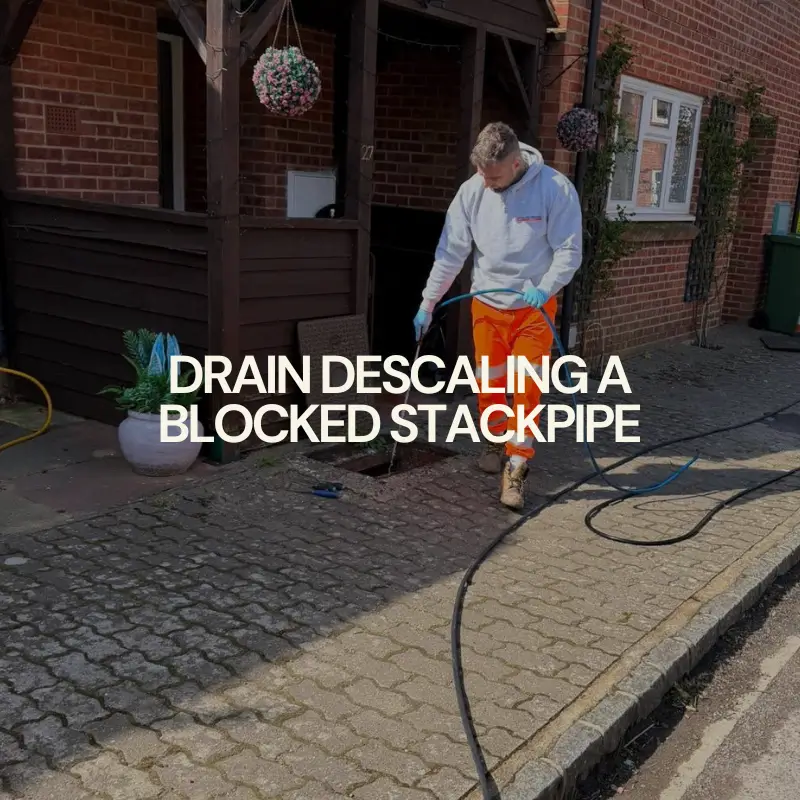
Drain Descaling a Blocked Stackpipe: How We Restored Flow at a Customer’s Property

A blocked stackpipe can bring a household to a standstill. Wastewater has nowhere to go, unpleasant odours fill the property, and everyday tasks like flushing the toilet or running a bath become impossible. Recently, we attended a customer’s property to carry out drain descaling on a severely blocked stackpipe, and the results spoke for themselves.
In this article, we walk you through what happened, what a stackpipe actually is, why scale buildup occurs, and how our descaling process got everything flowing again.
What Is a Stackpipe?
A stackpipe (also known as a soil vent pipe or drainage stack) is a vertical pipe that runs through one or more floors of a property. According to Designing Buildings Wiki, it connects the drains from bathrooms, kitchens, and utility areas and carries wastewater down to the underground sewer system. The pipe also vents above the roofline, allowing air to circulate and preventing vacuum locks in the drainage system.
Because the stackpipe handles wastewater from multiple sources within the home, any blockage or restriction can affect every connected fixture. That is exactly the situation our customer was facing.
What Caused the Blockage?
When we arrived on site and carried out an initial assessment, it became clear that heavy scale buildup inside the stackpipe was the root cause. Over time, minerals dissolved in the water supply, along with soap residue, grease, and general waste deposits, had bonded to the inner walls of the pipe. Layer by layer, this scale had narrowed the pipe’s internal diameter until water could barely pass through.
Scale buildup is especially common in areas with hard water. The south of England, including Dorset, is well known for having hard to very hard water. The Drinking Water Inspectorate provides a useful map showing typical water hardness levels across England and Wales. Hard water contains elevated levels of calcium and magnesium, and when this water flows through pipes repeatedly, those minerals gradually deposit on the pipe walls, forming limescale.
The U.S. Geological Survey (USGS) also notes that when hard water is heated, solid deposits of calcium carbonate can form, further reducing pipe efficiency and lifespan. While that reference relates to water supply pipes, the principle is the same for drainage systems exposed to warm wastewater from showers, dishwashers, and washing machines.
Signs You Might Need Drain Descaling
Not sure whether your drains have a scale problem? Here are some common warning signs to look out for:
- Slow draining sinks, baths, or showers – if water takes longer than usual to empty, scale may be narrowing your pipes. Our guide on how to unblock a shower drain covers quick fixes, but persistent issues may point to deeper scale buildup.
- Gurgling sounds from your drains or toilet, which suggest air is being trapped by a partial blockage.
- Frequent blockages – if you find yourself dealing with recurring clogs, the underlying cause could well be scale restricting flow. Take a look at our article on 5 signs your outside drain is blocked for more pointers.
- Unpleasant smells coming from plug holes or near the stackpipe itself.
- A slow draining toilet can also indicate a problem further down the line. We have covered this in more detail in our slow draining toilet guide.
If any of these sound familiar, it is worth getting your drains inspected sooner rather than later.
How We Carried Out the Drain Descaling
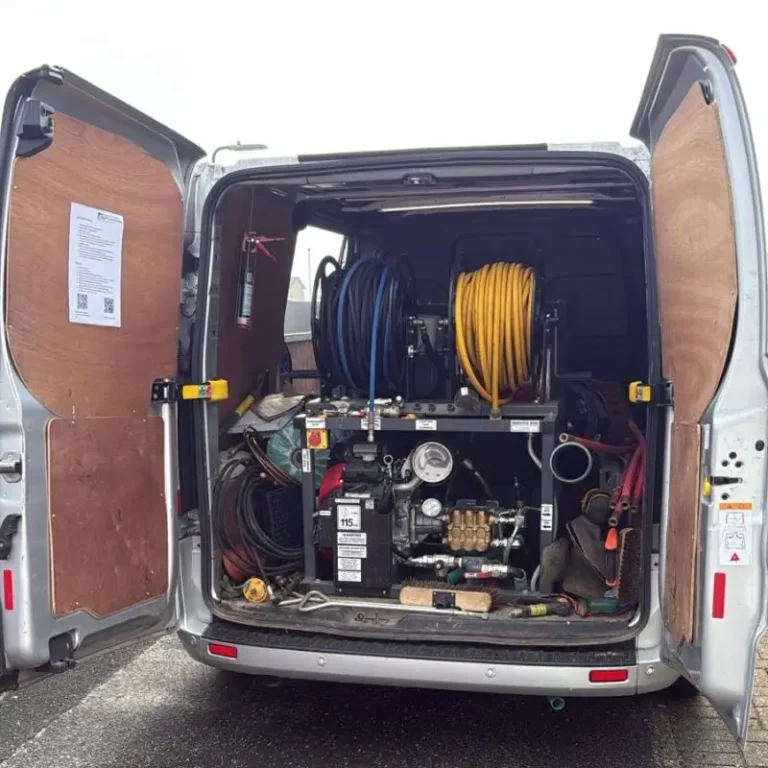
For this particular job, we used a combination of high-pressure water jetting and specialist descaling equipment to break down and remove the hardite mineral deposits lining the inside of the stackpipe.
Here is a general overview of the process we followed:
- Initial inspection – We used a CCTV drain survey camera to assess the condition inside the stackpipe, identify the extent of the scale, and check for any structural damage.
- High-pressure jetting – A high-pressure water jet was fed into the pipe to break away the outer layers of scale and flush loose debris through the system.
- Mechanical descaling – For the more stubborn, calcite deposits that jetting alone could not shift, we used specialist rotating descaling tools. These physically scrape and cut the scale away from the pipe walls, restoring the original bore diameter.
- Final flush and camera check – Once the descaling was complete, we ran another camera inspection to confirm the pipe was clear and structurally sound.
The result was a stackpipe restored to full capacity, with water flowing freely once again. Our customer was delighted with how quickly we were able to resolve the issue.
Why Professional Drain Descaling Matters
It can be tempting to try chemical drain cleaners from the supermarket, but these products are rarely strong enough to deal with significant mineral scale. In some cases, harsh chemicals can even damage older pipework, particularly cast iron, making the problem worse.
Professional descaling ensures the job is done safely and thoroughly. With camera-guided inspections before and after the work, you know exactly what the issue was and can see the results for yourself.
If our inspection reveals that your pipes have deteriorated beyond the point where descaling alone will solve the problem, we can also advise on drain relining or drain repair as longer-term solutions.
How Often Should You Descale Your Drains?
There is no single answer that fits every property. It depends on your water hardness, the age and material of your pipes, and how the drainage system is used. As a general rule, if you live in a hard water area and your property has older pipework, scheduling a drain cleaning every couple of years can help prevent serious scale buildup and keep things flowing smoothly.
Regular maintenance is far more affordable than dealing with a full blockage or, worse, a burst or collapsed pipe.
Need Help With a Blocked Stackpipe or Drain Descaling?
If you are experiencing any of the symptoms we have described, or you suspect your stackpipe may be blocked, do not wait for the problem to escalate. We offer a 24/7, 365-day emergency drain unblocking service with no call-out fee, and we always discuss costs before we arrive so there are no surprises.
Whether it is a blocked stackpipe, a scaled-up sewer line, or any other drainage issue, we are here to help. Get in touch with us today through our contact page or explore the areas we cover to see if we can assist at your property.
For more helpful advice, take a look at our ultimate drain unblocking guide for tips on keeping your drains in top condition.